The Office for the Establishment of War and Economic Crimes Court for
Liberia (OWECC-L) has expressed deep concern over the exclusion of key
transitional justice stakeholders, including war victims, survivors, persons
with disabilities, from the unveiling of the prototype for a National Memorial.
OWECC-L, which was created by Executive Order 131 to lead the process to
establish a War and Economic Crimes Court and Anti-corruption Court, was also
excluded from the unveiling ceremony.
The Memoria prototype was unveiled at the Executive Mansion on Friday,
November 6, 2026, as part of an initiative intended to establish a national
memorial that would serve as a lasting reminder of Liberia’s fourteen years of
civil conflict and the devastating consequences of the country’s wars.
OWECC-L recognizes and welcomes efforts by the Government of Liberia to
establish a national memorial as an important component of the country’s
transitional justice process.
OWECC-L believes a national memorial has the potential to become a place
of remembrance, reflection, education, healing, and national reconciliation. It
can also help future generations understand the consequences of conflict and
the importance of protecting peace, justice, human rights, and the rule of law.
However, the Office says the manner in which the prototype was unveiled
raises serious concerns about inclusiveness and national ownership of an
initiative that is fundamentally about the experiences, suffering, resilience,
and aspirations of the Liberian people.
The Executive Director of OWECC-L, Dr. Cllr. Jallah A. Barbu, described
the exclusion of OWECC-L and, more importantly, the absence of representatives
of war victims, survivors, and persons with disabilities from the unveiling as “a
shock and unacceptable.”
According to Dr. Barbu, while the Executive Mansion has the authority to
initiate national programs, memorialization of Liberia’s civil wars cannot be
treated solely as a government project, stressing that the people whose lives
were directly affected by the conflict must have a meaningful voice in
determining how the nation remembers its past.
He emphasized that memorialization is not simply about constructing a
physical structure. Rather, it is about preserving the truth of what happened,
honoring those who lost their lives, recognizing those who survived,
acknowledging the suffering of communities, and ensuring that future
generations understand the cost of violence.
OWECC-L believes that a national memorial should be developed through a
broad, transparent, and participatory national process that places victims and
survivors at the center.
The Office notes that Liberia’s conflict affected virtually every segment
of society. Thousands of Liberians were killed, displaced, injured, sexually
violated, separated from their families, forced into exile, or left with
physical and psychological scars. Many communities continue to carry the
consequences of the war decades later.
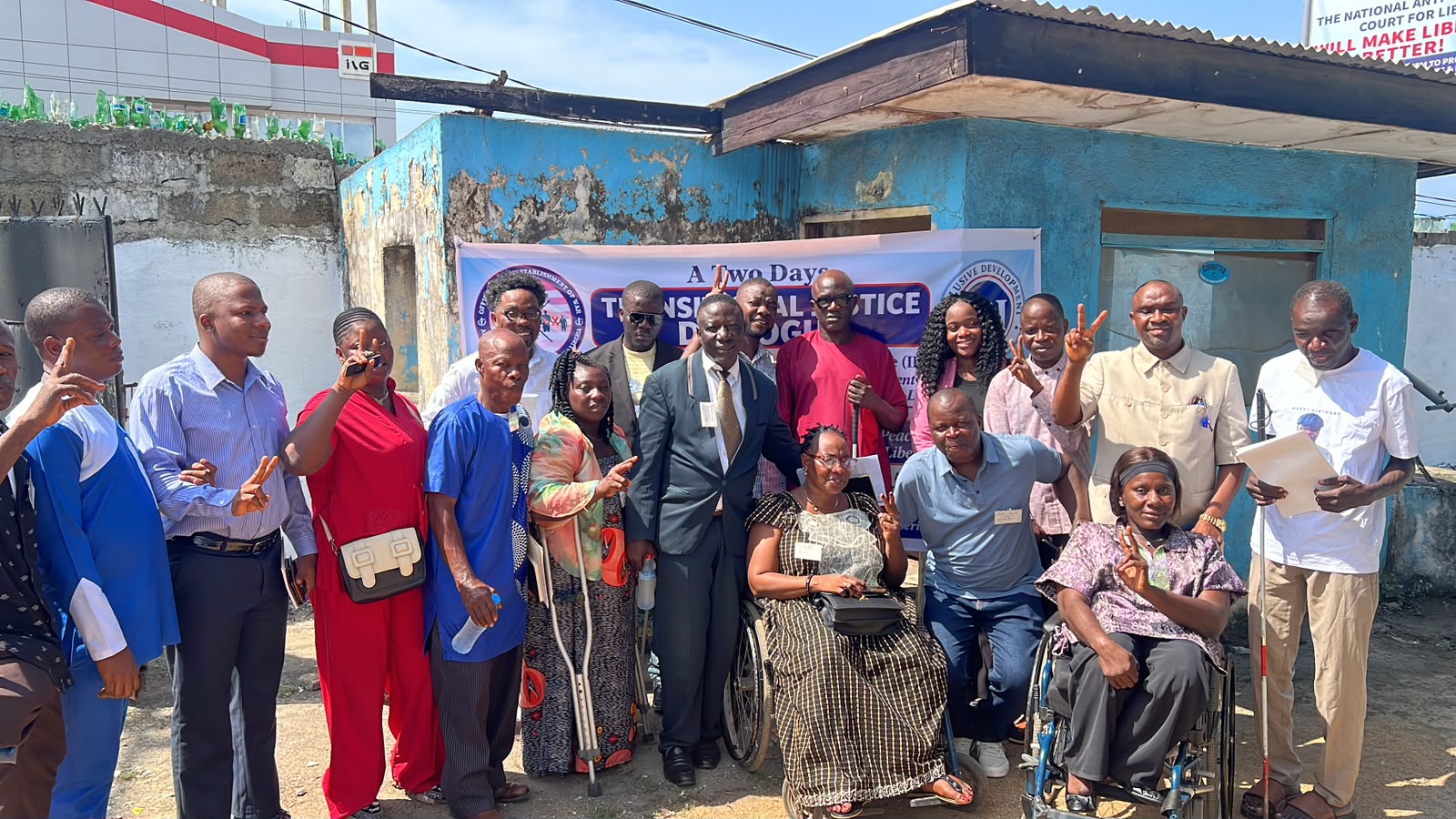
Among those most affected are persons with disabilities who acquired
disabilities as a direct consequence of the conflict, as well as persons with
pre-existing disabilities whose vulnerabilities were compounded by war.
OWECC-L, therefore, believes that persons with disabilities should not only
be invited to observe the memorialization process. They should be included as
active participants in its design, development, implementation, and management.
The Office further stresses that victims and survivors should have the
opportunity to contribute their stories, experiences, cultural expressions, and
perspectives to the national memorial.
A memorial that does not adequately reflect the voices of those who
experienced the conflict risks becoming a monument to the conflict rather than
a meaningful national space for truth, remembrance, healing, and
reconciliation.
OWECC-L maintains that Liberia needs a national memorial that belongs to
the entire country and not to any single institution, administration, political
party, or group.
OWECC-L is therefore calling on the Executive Mansion to reconsider its
current approach and open the national memorialization initiative to broader
consultation.
The Office recommends that the Government convene a national consultative
process involving, among others:
The Office also recommends that the Government consider holding
consultations across Liberia, particularly in communities that experienced some
of the most devastating consequences of the civil wars.
OWECC-L recognizes the authority and responsibility of the Government of
Liberia to lead national initiatives. However, the Office believes that
leadership must be accompanied by openness, consultation, and inclusion.
Department
of Press and Public Affairs
(OWECC-L)
+231775144278 or + 231886119930