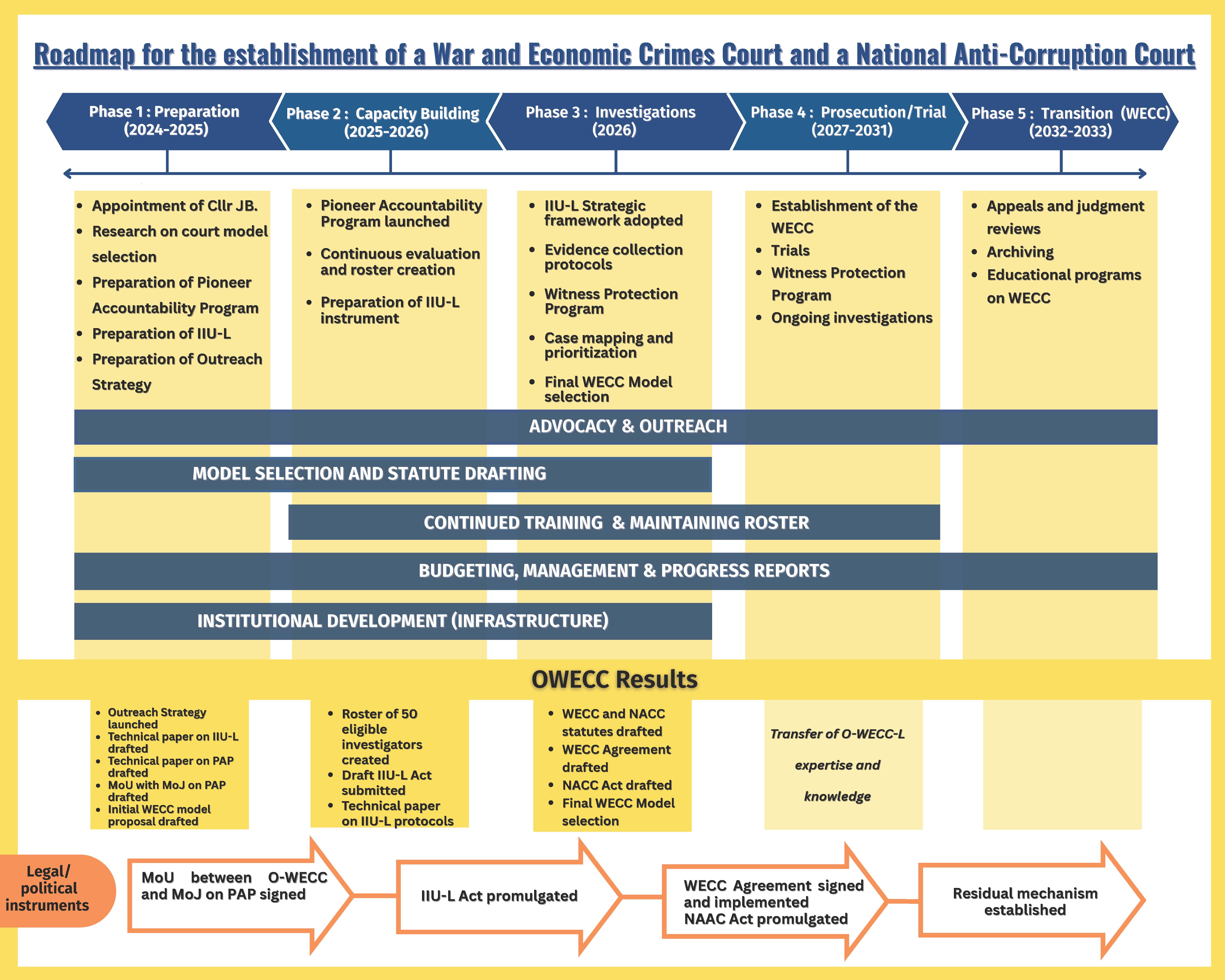
Phase 1: Preparation
Completed 2024 – 2025Laying the legal, institutional, and strategic foundation for both courts — from leadership appointments to drafting laws and launching public outreach.
Appointment of legal leadership (Cllr JB) to begin institutional organization and coordination.
Study of hybrid courts, international tribunals, and domestic accountability systems to determine the best structure for the WECC and NACC.
Early accountability efforts in cooperation with the Ministry of Justice, including technical papers, MoUs, and program launch.
Drafting technical papers, legal instruments, protocols, and the IIU-L Act to build the legal framework for the investigative institution.
Outreach strategy preparation, advocacy activities, and public engagement to build national trust in the process.
Drafting statutes, agreements, and laws required for both courts before implementation begins.
Draft laws established · Initial court models proposed · Outreach strategies launched · Foundational institutions legally prepared
Phase 2: Capacity Building
In Progress 2025 – 2026Strengthening human resources, institutional systems, and operational readiness — from training investigators to establishing witness protection.
Creating a roster of 50 eligible investigators prepared for investigations, prosecutions, evidence handling, and court operations.
Ongoing evaluation and maintenance of the investigator roster to ensure quality control and continuous professional readiness.
Adoption of the IIU-L strategic framework, making the institutional structures from Phase 1 fully operational.
Developing systems for gathering and preserving evidence including chain of custody and documentation standards.
Establishing witness protection mechanisms to safeguard individuals who may face retaliation for cooperating with investigations.
Skilled investigators prepared · Institutional systems functional · Witness protection established · Evidence procedures standardized
Phase 3: Investigations
Upcoming 2026Beginning active case work — mapping, prioritizing, and actively investigating war crimes and corruption cases.
Identifying and analyzing major war crimes cases and corruption networks, assessing evidence and prioritizing high-impact cases.
Investigators begin gathering testimonies, documents, financial records, and forensic evidence.
Confirmation of the final WECC structure as Liberia transitions from planning to active operational implementation.
Cases investigation-ready · Court systems finalized · Prosecutorial preparation begins
Phase 4: Prosecution & Trial
Upcoming 2027 – 2031The core accountability phase — the War and Economic Crimes Court becomes operational and trials commence.
The War and Economic Crimes Court becomes fully operational and open for proceedings.
Hearings, criminal prosecutions, presentation of evidence, and delivery of judgments for major cases.
Protection programs continue throughout the trial phase as witnesses remain vulnerable during proceedings.
Due process upheld through a structured appeals process, legal reviews, and judgment reconsiderations where necessary.
Investigations continue alongside prosecutions as new evidence and cases may emerge during the trial period.
Major cases prosecuted · Judicial accountability functioning · Legal precedents established
Phase 5: Transition
Upcoming 2032 – 2033Ensuring long-term sustainability and legacy after court operations conclude — archiving, education, and institutional continuity.
Preservation of all records and evidence for national history, future legal reference, and academic and institutional learning.
Public education programs on the WECC process, accountability, rule of law, and national reconciliation.
A smaller institution remains active to handle remaining legal matters, preserve records, and manage any unresolved issues.
OWECC-L transfers expertise and institutional knowledge to ensure continuity after the original structures transition out.
Court legacy preserved · Knowledge institutionalized · Long-term accountability mechanisms retained